What has Kaggle learned from 2 million machine learning models?
Anthony Goldbloom, founder and CEO of Kaggle
UPDATE:Video recording of the talk available here
Kaggle is a community of almost 450K data scientists who have built almost 2MM machine learning models to participate in our competitions. Data scientists come to Kaggle to learn, collaborate and develop the state of the art in machine learning. This talk will cover some of the lessons on winning techniques we have learned from the Kaggle community.
Join PyDSLA for a talk by Erin LeDell Intro to Machine Learning with H2O and Python
Get your tickets HERE
Summary:
This workshop will provide an overview of how to use H2O, the scalable open source machine learning library, from Python. The core algorithms of H2O are implemented in Java, however, fully-featured APIs are available in R, Python, Scala, and also through a web interface. The focus of this hands-on workshop will be the “h2o” Python module.
Tickets available HERE
Talk:
Jihoon Son Presents - Introduction to Apache Tajo: Future of Data Warehouse
Abstract: Apache Tajo is a data warehouse system for Web-scale data. It provides virtual integration of a multitude of diverse data sources, thereby facilitating easy and rapid data integration which has been regarded as an essential, but heavy step in business intelligence. In addition, it has a fault-tolerable distributed query engine for accelerating query speed. With the “query federation” and “distributed processing” capacities, Tajo is capable of providing users with reliable and efficient analysis of Web-scale data spread on multiple sources. I will introduce Apache Tajo including its overall architecture, current state and challenges, and discuss advantages what Tajo can bring to users. In addition, I will give a brief demo of Tajo.
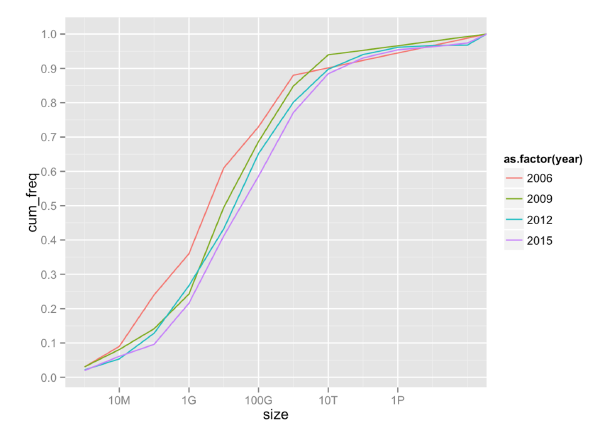
With so much hype about “big data” and the industry pushing for “big data” analytical tools for everyone, the question arises how many people have big data (for analytics) and how many of them really need these tools (which are more complex and often more immature compared to the traditional tools for analytics).
If you’ve never heard of kaggle, I guess the first question I have to ask is “how did you end up on DataScience.LA?” :)
Kaggle is one of the foremost machine learning competition websites on the internet. Companies from GE to Criteo and everything in between create competitions. These competitions are in the form of a dataset, ranging from small to relatively large (up to many many gigabytes), a stated goal (such as predicting an event or finding a numeric value) and an evaluation criteria. The Kaggle community has grown in the last few years, so that now competitions often host thousands of participants!
One of the best things I like in working at CARD.com is that I am not only crunching R code in 24/7, but I also have the chance to interact with and improve the related data infrastructure with some interesting technologies.
After joining the company in January, I soon realized that while Impala is a very powerful database for handling data that do not comfortably fit in MySQL, it’s still not as fast as one might expect when querying large amount of data from R. Sometimes I had to wait several minutes for a query to run! So I used this spare time to think about how to improve the workflow.
Our next Data Science meetup:
Winning Data Science Competitions
by Jeong-Yoon Lee
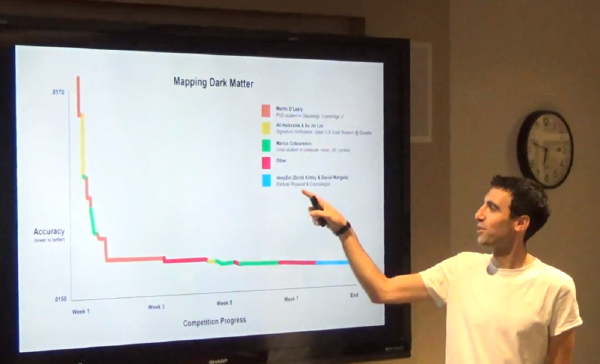
In this talk, I am going to share my experiences in data science competitions. After an overview of the competition structure and best practices, I will present the 1st prize winner’s solution for KDD Cup 2015 with the behind-the-scenes story.
In a partnership with the City of Los Angeles government, LA City College (LACC) has formed a civic data analysis team for 2- and 4-year college students and anyone looking to enter the data science profession. The team will complete a beginning-level data analysis project on Friday afternoons during a 10-week period during the Fall 2015 semester, using data provided by the City of LA. We will present our results to City of LA staff in December.
Click HERE to sign up on Eventbrite!
This is the second event of the new Data Warehouse, Business Intelligence and Analytics meetup.
Talks:
1. Eduardo Arino de la Rubia: MySQL to Vertica with Tungsten Replicator
In this very (very) short talk, I will discuss how you can, for free, stream your MySQL data to a Vertica Community Edition cluster, and do near real-time analytics on up to 1TB of data.
On May 14th at the Venice Arts Center, the Los Angeles Python and Data Science communities were fortunate to hear a talk from world-renowned expert and CEO of Dato, Carlos Guestrin. Often times when you have a meetup where a presenter is tightly identified with a company, the concern is that the presentation will fundamentally become a product pitch. We had nothing to be worried about in this case - Carlos presented for nearly an hour on a wide range of subjects from how the Machine Learning pipeline has changed over time to Deep Learning!
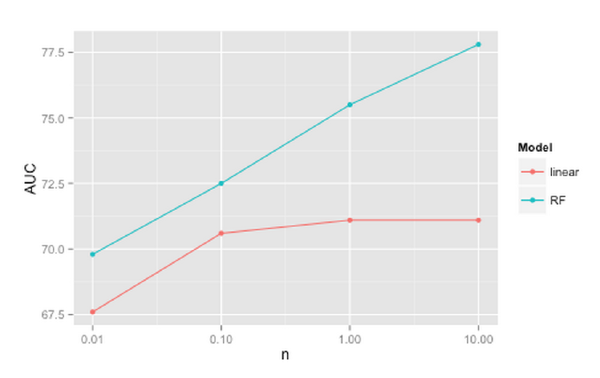
I currently have the need for machine learning tools that can deal with observations of the order of 10 millions in the context of binary classification. That kind of data is a few GBs in size and it fits comfortably nowadays in the RAM of a decent single machine. It is a trivial task for linear models, as there are plenty of open source tools that can train a logistic regression with this amount of data on a single machine in a few seconds, even while using only 1 processor core (many of these tools are single-threaded). Linear models are also the gold standard of large-scale machine learning that can run on clusters, processing very large distributed datasets.
*** EVENTBRITE LINK HERE ***
PyDSLA - Dato: A Platform for Practical, Large-Scale Machine Learning
Join PyDSLA for a talk by Carlos Guestrin about Presents Practical, Large-Scale Machine Learning in python.
Summary:
Data Science is perhaps the hottest profession on the market today. Folks with backgrounds ranging from Statistics and Physics to Engineering and Computer Science are eager and excited to transition to this field. However, designing and deploying data analysis and machine learning apps at scale is a significant challenge to overcome: For some folks, machine learning algorithms and methods can be obscure, too mathy, and disconnected from practice. For others, writing and deploying scalable software requires significant effort, which distracts them from focusing on their deep analytic efforts.
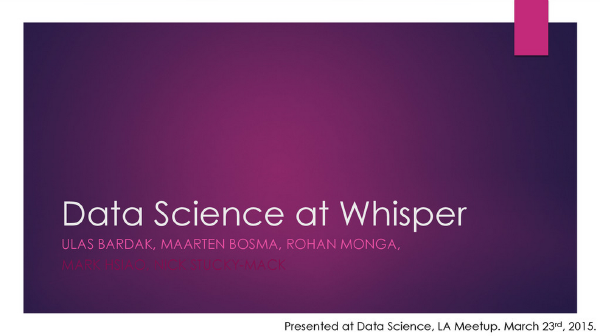
Where were you on the evening of Monday, March 23rd? Do you remember what you were up to? If you were one of the over 100 attendees to the latest installment of Szilard’s Data Science Meetup, you definitely remember! You were at Cross Campus Santa Monica, receiving a teaser on fundamentals of probabilistic programming by LA ML Meetup founder Rob Zinkov along with a detailed master class on modern machine learning architectures and approaches by Los Angeles’ own Whisper!
What is DataFest? # DataFest is a team competition, where a team of up to 5 undergraduate students has less than 48 hours to provide the best insight gleaned from a large, complex data set — and communicate that insight to an audience of their peers and the DataFest judges. DataFest 2015 will be April 24th through the 26th, beginning at 6pm on Friday the 24th.
This meetup will be hosted by Google and we’ll have Peter Lipman and Pete Meyer talk about the data science/statistics projects they have been working on at Google.
Human Evaluation Comparisons: Common Framework with Applications
We designed a study to determine whether being on device influenced a quality evaluator’s perception of ads quality. Here, we present a common framework, developed into an internal R package, that was used to analyze the study.
The LA Data Warehouse, Business Analytics and Analytics meetup had a fantastic first event with a great audience (full house), an awesome host (thanks Edmunds: Punnoose for taking the lead and the Team onsite and helping) and a great mix of 3 talks overviewing the field.
The Shiny framework, by RStudio, is growing in popularity as a tool that makes it easy for R developers to leverage the web as a deployment platform for sharing their analysis. However, since the very earliest release of Shiny, the development group has been bombarded with the same series questions over and over again, questions like “Does it work with d3.js?” and “Can I use JavaScript in Shiny?”
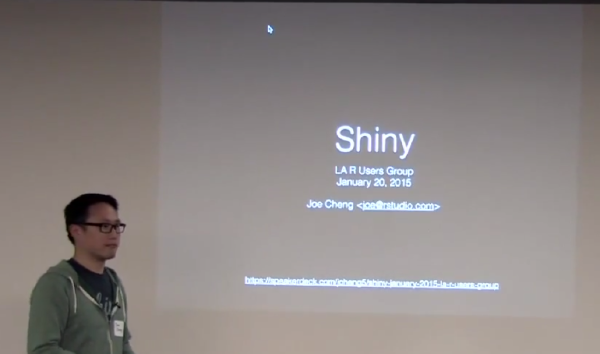
The Shiny framework is a web application framework for the R programming language, designed by Joe Cheng, to help R programmers turn their analysis into interactive web applications. Fortunately, it does without requiring that the R programmer know HTML, CSS or JavaScript - greatly widening the possible audience of users. At the January DataScience.LA R Meetup, we were fortunate to have Joe Cheng, Software Engineer at RStudio and original architect of Shiny present an introduction to Shiny.
Join PyDSLA for a talk by Matthew Rocklin about the high level APIs being developed for Python for expressive data manipulation and analysis.
Summary:
Pandas and NumPy serve us well. They give interactive high-level access to efficient low-level code. As datasets grow larger than memory this low-level code becomes obsolete but the high-level interface remains valuable. Blaze connects that high-level interface to a number of other computational systems like SQL, Mongo, or Spark, extending the scope of interactive analysis. In this talk we go over common use cases and Blaze as well as a bit of its internal design.
This was originally posted on the author’s LinkedIn
You will find lots of advice on how to get a job as a data scientist. I want to add some signal to the noise.
I happen to be hiring for a Data Scientist or two as of this writing, and was thinking of doing a blog post on offering advice for those looking. But then I thought of something better and more insightful: It is a cut-and-paste of an email that I sent to our Director of Talent Acquisition last week when he asked me, “Can you share with me what you’re looking for in regards to your Data Scientist candidates?”