I’m pleased to announce the first event of our new Python Data Science LA meetup, started by two of us here at DataScience.LA (our very own Szilard and Eduardo).
We’ll have 5 speakers at this event, covering various aspects of the Python Data Science ecosystem (NumPy, SciPy, pandas, matplotlib, scikit-learn, NetworkX, NLTK, IPython notebook, etc.)
Joe Cheng is a software engineer. Unfortunately the term gets thrown around pretty lightly, so I’d like to make sure that I convey the appropriate amount of gravitas when I refer to him as such. Joe Cheng is a *great* Software Engineer. He has worked for some of the largest technology companies on the planet, building cutting edge tools which empowered the web browser as a full blown platform instead of a historical curiosity. Joe is one of those software engineers who saw a future with the web as a platform for modern software, then worked hard to make it a reality. When the time came to build the next generation of data science IDEs, an IDE targeting the web as a platform, RStudio called Joe.
There comes a time in a software toolchain’s lifecycle where the focus shifts from developer productivity and preference to the ability to deploy solutions in production which coexist gracefully in the enterprise. Configuration management and dependency management are two of the first points of friction in this transition, as the free-wheeling methods preferred by developers are at odds with the structured methods and isolation desired by administrators, who serve as gatekeepers to enterprise deployment. R is currently at this very point in the transition, in the midst of transformation from a language and environment used primarily in academic research to its growing place in the enterprise. At useR! 2014 there were a series of presentations on how dependency management can be addressed within the R ecosystem, ranging from “provider” side options (e.g. freezing CRAN and private repositories) to the client side options, where a project maintains its own dependencies as part of its codebase.
This is a re-publication of a blog post from a blog I created not long before we got the idea to start DataScience.LA, and in many aspects it is the genesis of DSLA (the blog’s name, the people getting together - thanks Eduardo, Amelia and Leigh). It was also the spark that lead to the creation of the Python Data Science LA meetup.
I have been following Big Data, Hadoop in particular, for the past four years and a lot has changed since then. At the time I was looking for the next big wave of technologies, especially on the back end of development as that was my forte at the time. After our initial introduction, the more I learned the more I felt Hadoop was the right tool to get the job done. Focusing upon the development aspects of job vs actual maintenance of the servers/cluster has always been a no-brainer for me. Now that Hadoop has been adopted by a wide variety of industries and has grown quite popular, it has become much more apparent that there are indeed areas where Hadoop is lacking. Security and real-time analytics are two of these concerns which both affect real-time processing and reporting, but fortunately there is a lot of current work happening to address these limitations. Consequently, there is a group of big data vendors who are investing a large number of resources as a remedy, bringing us newer tools such as Yarn, Tez, Storm, etc. Also, acquisitions of XA Secure by Hortonworks and Gazzang by Cloudera are contributing to the solving these issues around security.
First things first, Dirk Eddelbuettel was recently named ordinary. This seems contradictory, since Dirk is a known HPC expert, an organizer of the R in Finance conference, the creator of Rcpp, and a Debian contributor. These are only a few of the many accolades bestowed upon Dirk without even a hint of puffery. And yet, Dirk Eddelbuettel is considered ordinary. What makes Dirk ordinary? It should be mentioned that to the Vienna-based nonprofit that provides R’s leadership, the R Foundation for Statistical Computing, ‘ordinary’ means something quite different to the lay person. Ordinary members provide guidance and direction for the R Project for Statistical Computing. It’s hard to imagine someone more qualified than Dirk for this task.
At useR! 2014 Ramnath Vaidyanathan gave a tutorial and a presentation on one of his current project, rCharts. This R package allows you to create, customize and share interactive visualizations straight from R. rCharts leverages several existing javascript visualization libraries such as polychart, MorrisJS, NVD3, xCharts, HighCharts, leaflet, and Rickshaw, providing R users a fantastic array of new features and visualization styles.
(This is my third post on statistics graduate school. You can read the first, on coursework, the difference between a Masters and a PhD, and proving your worth here, and the second, on advancing to candidacy, writing the dissertation, and having fun in grad school, here.)
At the useR! 2014 conference, without a doubt one of the overriding themes was R’s history, legacy, and future as an interface into the “best of the best” algorithms which were available. Romain Francois’ package, Rcpp11, is very much the spirit and the letter of this ethos and telos of R as an interface. This package is a reimplementation of Dirk Eddelbuettel’s Rcpp package with an emphasis on C++ 11’s features. Whether it’s an R user hitting performance limitations, or someone trying to integrate a C/C++ library into their analysis, Romain’s tools are there to help.
Martin Maechler is a member of R-Core. This distinction puts him in the very apex of understanding of the R programming language and environment. He is a professor of statistics with wide and varied interests and a leading expert in statistical computing environments. He is also a prolific programmer, evidenced by his maintenance of the officially recommended cluster package for unsupervised clustering and analytics, the lead developer of Emacs Speaks Statistics, and co-maintainer of the Matrix package… plus too many other contributions to list them all here.
Last week the LA R meetup featured 5 speakers each highlighting a few things they had found interesting at the useR! 2014 conference (which I had the pleasure of helping to organize this year in Los Angeles). This meetup proved to be interesting even to those of us who attended the conference (which was about half of our audience), simply because there were so many cool things to hear and enough parallel sessions at the conference that no one could possibly capture all of the action.
Heather Turner is a biostatistician and Associate Fellow at the University of Warwick, as well as a consultant. She is a former editor of the R Journal, was a local organizer for the useR! 2011 conference, and holds a wealth of information about the field of data science, the state of the technology, and the wider community.
Last week, I got the opportunity to share the highlights from the eyeo festival at the DataVis LA meetup. The eyeo festival is a yearly event held in Minneapolis that draws together artists, technologists, designers, and many more people who work with art and computers. As I said in the meetup description, a lot of the things that caught my eye this year could be described better by the term “art” than straight “data visualization,” although there’s usually both at the festival. I also really liked that this year’s festival emphasized the history of computer art and data visualization. By bringing in Frieder Nake, Lillian Schwartz, and Roman Verostko, the organizers grounded us in the history that started in the 1960s.
At useR! 2014, one of the most anticipated presentations was Joe Cheng’s Shiny: R made interactive. It was but one of the of a fantastic series of talks by RStudio representatives; check out Winston Chang’s ggvis: Interactive graphics in R for another great talk. Shiny begins with your R code and ends with the customer’s view: an interactive, browser-accessible application. This enables you to place a great deal of power into your users’ hands to customize their view and provides a variety of new and innovative ways to interact with the data, such as by tuning parameters and focusing on sub-populations. Essentially, Shiny functions by allowing you to “wire up” up a reactive application, greatly speeding up the development of a data and analysis based web app.
Today I am happy to announce that we are expanding our partnership on several fronts with my friend Subash D’Souza, a leader of the Big Data community in LA.
During the past few years I have been organizing several data science meetups in Los Angeles (LA R, DataVis LA, Data Science/Machine Learning) and Subash has provided the same kind of leadership on the big data front (LA Hadoop, HBase, LA Big Data). While I think of big data as primarily technology and of data science as a blend of statistics and technology (and not only for large data sets), there is clearly a significant overlap between these two fields. Considering this overlap, we have already been collaborating for some time regarding these various meetups, e.g. organizing joint events or speaking at one another’s meetups.
As someone who has spent a significant amount of time ‘data wrangling’ outside the field of data science, I found this recent New York Times article both highly interesting and nothing new - I’ve seen the same issue discussed in a variety of fields with similar automation solutions presented each time. Granted, there are fields where this janitorial drudgery is absolutely necessary, such as molecular biology. As a scientist working on researching mRNA expression you certainly have to keep RNase-free conditions, meaning you have to ‘clean up’ your bench in a more detailed way than you’d ever imagine before you can run your first PCR cycle. This includes specific protocols for washing your dishes several times with special water before you even start because if you don’t, you’re not likely to get any bands in your electrophoresis gel and you’ll lose several days (or weeks!) of work.
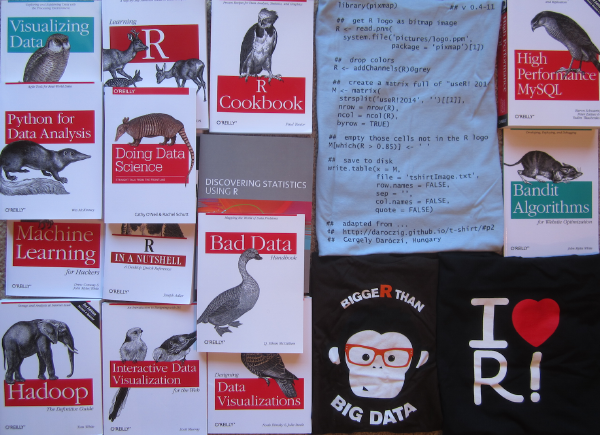
We have a few pieces of swag that we are raffling off to the community at our upcoming meetup events. Our stash consists of 25 data-oriented books, primarily from O’Reilly plus 25 T-shirts from useR! 2014 conference and Revolution Analytics (see picture above). Did we get your attention?