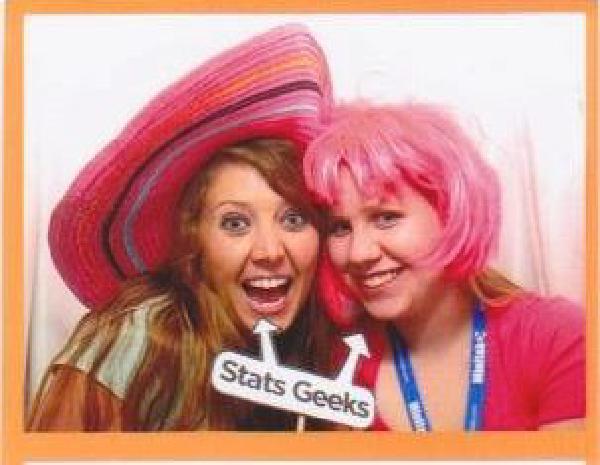
Hadley Wickham is famous. He’s not Kardashian famous, but walking around useR! and seeing the community’s reaction to him, there’s no question, he’s ‘R famous’. If you have the good fortune to see his talks, tutorials, or sessions in person, you owe it to yourself to do so. He projects depth and wisdom with a booming voice, which combines with a hard-won confidence brought about by years of honing his craft and developing his expertise. He takes as much time as is needed to answer questions, listens to every single bit of feedback and succeeds in making you feel that what you say indeed matters. Hadley Wickham has poise. It’s also quite obvious, if you watch him for long enough, that this fame suits him like an itchy sweater made by a loving grandparent. It brings warmth and it comes from a place of love, but it’s always a little uncomfortable regardless of how well it may fit.
I think it’s interesting that R is an extremely fixable language.
Hadley Wickham
I’ve had a lifelong fascination with maps, and working with R definitely enables my map habit. Perhaps there’s something about being an immigrant that made me particularly introspective, since from a very early age I was aware that I was “from” one place on the map and now lived at this “other place.”
By now I’m sure you’ve checked out our blog and have wondered, ‘How can I contribute my ideas and share my projects with the community?’ There are two ways to contribute content to DataScience.LA, either as a regular contributor or through our Blogging Accelerator. Our vision is to help unleash you, members of the community, as effective data science communicators while establishing Los Angeles as one of the leading places for data thinking, data journalism, and data science. (Ready to write a blog post right now? Send us an email at info@datascience.la to get started as a contributor.)
As a PhD graduate student in statistics here at UCLA, I’d like to talk a bit about our graduate program to give you an idea of what to expect if you’re interested in UCLA or statistics graduate school in general. First, it’s important to note that UCLA does not have a specific “data science” degree program at this point; the department offers a PhD and a Master’s degree, both simply labeled “statistics.” Some statistics departments have made the decision to change their name to “data science,” but that is often just a marketing decision. The UCLA department is pretty forward-thinking and has a focus on computation, so it’s fairly “data science”-y without having that exact name.
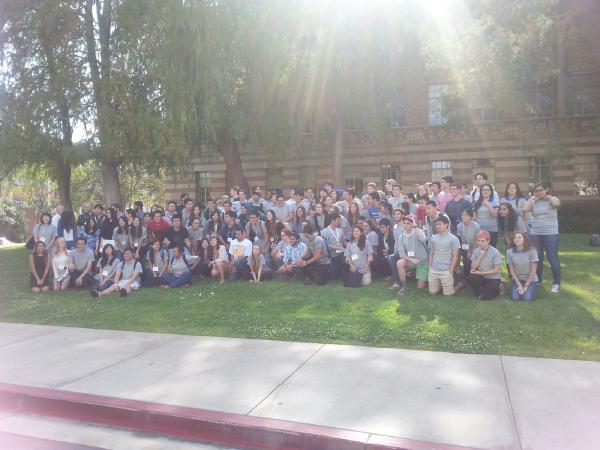
Below is the first of several exciting data science developments for the younger generation, happening right here in Los Angeles. This project is unique because it engages undergraduates in real data analysis, something that happens quite rarely in a classroom. If projects like this catch on as a new trend, we’re going to have some real competition for our jobs in a few years!
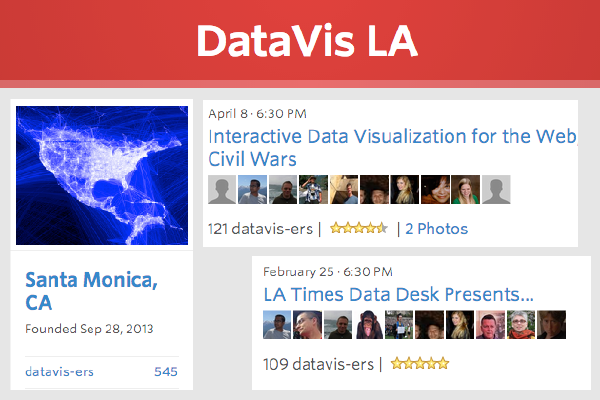
Data visualization helps us understand data. The DataVis LA meetup discusses the many aspects of data visualization: exploratory data analysis, presentation graphics, infographics, design, art, etc., and brings together a diverse community of data scientists, statisticians, software developers, BI specialists, business analysts, journalists, designers and artists with the goal of learning more about the art and science of data visualization from each other.
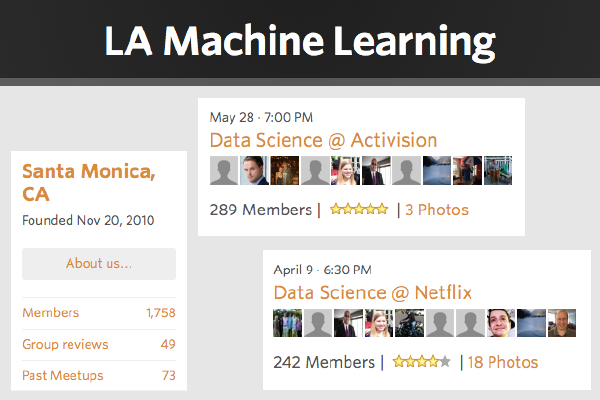
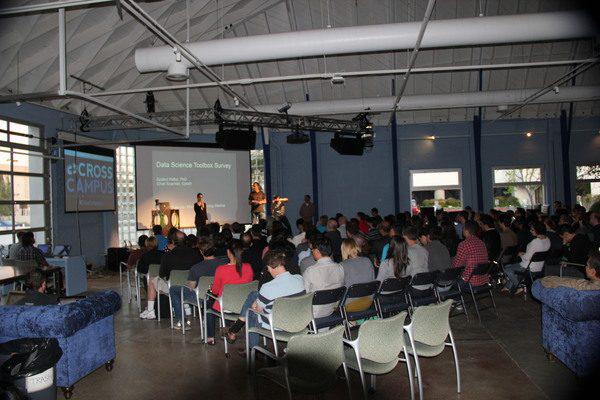
The LA Machine Learning Meetup began with events discussing a large variety of machine learning topics such as classification, clustering, neural networks, graphical algorithms, information retrieval, search, game theory, computational learning theory, reinforcement learning, collaborative filtering etc. More recently, a Data Science Track was launched with the focus on business applications and the entire process of data mining (e.g. business understanding, data collection, exploratory data analysis, data transformations, feature engineering, modeling, model validation, deployment, communication of results). While in fact Machine Learning is a part of Data Science and not the other way around, rather than starting a new meetup group, Data Science is featured within the already existing Machine Learning meetup.
Many of us here in the DataScience.LA Team were also involved in organizing the useR! 2014 conference, the annual get-together of the wonderful R community, which brought over 700 R users and developers from all over the world to Los Angeles this past July.
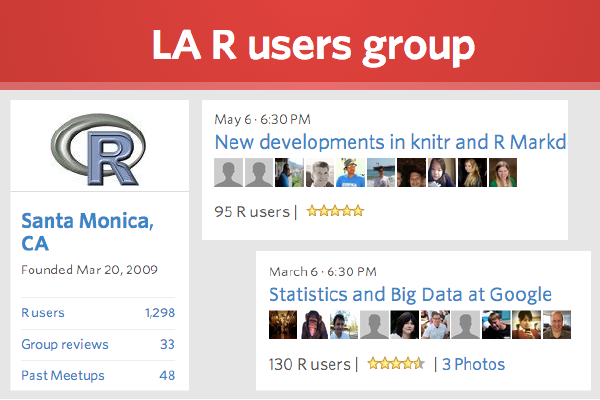
R is an open source software and programming language for data analysis, statistical modeling, visualization and data mining among other things. Recently, as the term “data science” has emerged to describe collectively these tasks, R has also become the primary tool of choice for data scientists. The LA R meetup began before this data science boom, back in 2009, by bringing together local users of R and featuring talks with world-class speakers while creating fruitful networking opportunities for its members. In retrospect, this group served as the very first data science meetup in Los Angeles and has significantly contributed to the development of our local data science community.
Welcome! We are launching DataScience.LA to provide a home for all the content (slides, code, videos etc.) for several meetups in LA (Data Science/Machine Learning, R, DataVis etc.) and to engage the Los Angeles data science community in an open, active discussion about best practices and new developments in the field.