Yesterday, I published a post here on DataScience.LA with a simple/basic benchmark for dplyr. It was the main part of a short talk at our last Los Angeles R meetup. Below, I continue my thoughts with some reflections on dplyr’s API and philosophy, AKA the other part of my talk.
Earlier this month I gave a short talk about dplyr at the Los Angeles R meetup. It was one of the 5 talks about the useR! 2014 conference, and you can see the summaries and slides from the other 4 talks here.
Part 2 of the dplyr tutorial is now available! Hadley will be covering Grouped Mutate/Filter, Joins, Do, and Databases. (You can find Part 1 of the tutorial here.)
For our viewers who have just discovered the wonders of R, keep in mind that this tutorial was filmed in early July of 2014. As R packages naturally update over time (well, depending on the programmers!), please make sure to check Hadley’s Githubfor the latest changes to the dplyr package.
At this meetup, five more LA R meetup members will present short talks of what they have learned at useR! 2014. This is the 2nd round of talks about useR! since we had twice as many volunteers to speak as we could accommodate in one meetup (indeed, useR! was that awesome). The first round of talks at our September meetup is summarized here (with slides).
Hadley Wickham (perhaps you’ve heard of his work) presented a 2 hour workshop on dplyr at this year’s useR! conference at UCLA. This tutorial was definitely a highlight of the week-long conference for me, and working on this tutorial video has also made me very appreciative of how versatile the dplyr package can be. It clearly is the chef’s knife of data science tools.
Hadley Wickham is hard at work, releasing packages which leverage the expressive power of R to keep easy things intuitive, and to make hard things possible. Having already developed a number of packages which address other steps in the data processing and analysis pipeline, he chose to address the process by which R developers ingest, manipulate, and transform data. This package, dplyr, is a narrowly focused library, designed to provide 90% of the functionality required in most data munging tasks. It may not solve every possible problem in data munging, but dplyr’s built in primitives will reduce your need to drop to “base R” for most common tasks. It does so by leveraging the magritr package’s “pipe” operator, and is inspired by dataflow programming constructs. It is fast, it is powerful, and it has been the single largest productivity boost that many of us here at DataScience.LA have adopted in 2014. In this video, Hadley provides a very quick introduction to the dplyr package, describing his philosophy behind the package’s design while providing a number of illustrative examples as to the flexibility, expressiveness, and power of this tool.
Last week the LA R meetup featured 5 speakers each highlighting a few things they had found interesting at the useR! 2014 conference (which I had the pleasure of helping to organize this year in Los Angeles). This meetup proved to be interesting even to those of us who attended the conference (which was about half of our audience), simply because there were so many cool things to hear and enough parallel sessions at the conference that no one could possibly capture all of the action.
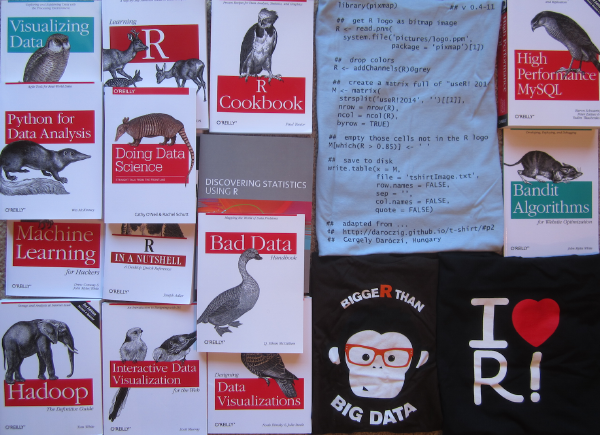
We have a few pieces of swag that we are raffling off to the community at our upcoming meetup events. Our stash consists of 25 data-oriented books, primarily from O’Reilly plus 25 T-shirts from useR! 2014 conference and Revolution Analytics (see picture above). Did we get your attention?