Matt Dowle holds a wealth of knowledge and is worth listening to for a variety of reasons. He has worked for some of the world’s largest financial organizations, holding positions at the focal point between money and data. He has been programming in R for well over a decade. He has lived the open source mantra, by not only consuming open source software but also releasing his own community contributions to CRAN. On top of those accomplishments, he’s also quite funny and spins a heck of a good yarn.
“At one point, the only source for daily R news was David Smith’s blog.” – Szilard Pafka
David Smith is an integral part of the R community. His background in computational statistics goes back to the early 90s . David has worked at Revolution R, one of the leading R companies, for nearly a decade. His name has been included in lists such as:
(Please click here if the video above doesn’t load.)
The video above is from an event at useR! 2014 consisting of Yasmin Lucero’s presentation plus an incredible panel discussion, which is included here. The title of the panel was “R’s Place in the Production Environment”, and was moderated by Tareef Kawaf, President at RStudio. Five high-profile members of the R community were on this panel, spanning the gamut of the enterprise:
(Please click here if the video above doesn’t load.)
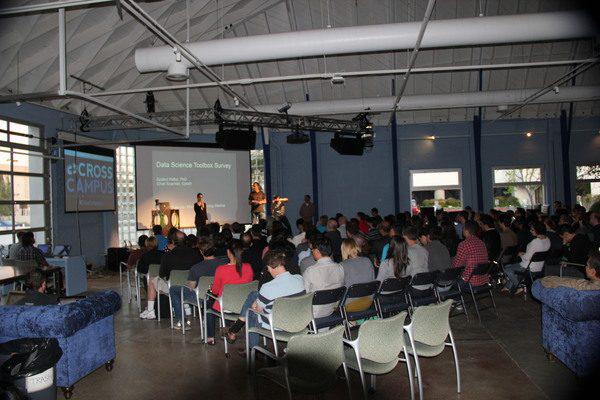
During useR! 2014, the LA R Meetup (run by Szilard Pafka) organized an event focused on R’s status in industry. This event took the form of a presentation by Yasmin Lucero, Senior Statistician at AOL-Gravity, followed by a panel discussion. The video above captures the presentation, where Yasmin provides an excellent overview of the current status of R in the enterprise and breaks down the taxonomy of solutions for which R is commonly chosen as a development platform. From batch reporting and dashboards for internal deployment to full blown public facing analytics data products, R has certainly found a home in business. Yasmin’s talk concludes with specific, operational aspects of managing R in the enterprise, such as library and dependency management. Enjoy the video and don’t forget to tune in for Part 2 of this session where the panel discussed “R’s Place in the Production Environment.”
You’ve asked and we’ve listened. The audio content from our DataScience.LA interviews will now be released as a podcast! Check us out on iTunes or point your podcast app to here!
We’ve already released the audio from the userR! conference interviews of Hadley Wickham, Max Kuhn, and Tal Galili on iTunes and hope to release upcoming interviews in podcast form shortly after our video blog posts. Thanks for being a part of the DataScience.LA community and we look forward to hearing more from you!
“One can acquire everything in solitude except character.”
― Stendhal
The Interview # Tal Galili is, in many ways, a central spoke of the R community. Both gregarious and thoughtful, he has grown his website R-bloggers into the definitive aggregation of the R community’s voice through his genuine, passion-driven intensity. Tal had a simple desire as a young programmer - to learn more about his chosen tools - and looked to the internet to find other voices like his. When googling for “R blogs”, Tal found numerous blogs about pirates, but only a handful about R. This interview details how Tal started R-bloggers and decided to challenge the status quo, as well as giving us a peek behind the curtain for his new projects.
Five LA R meetup members will present short talks of what they learned at useR! 2014
(plus we have 5 more volunteers for the following meetup!)
1. Timothy J. Triche, Jr., PhD
Fellow, Jane Anne Nohl Division of Hematology, USC/Norris Comprehensive Cancer Center
Winston Chang’s “Interactive Graphics with ggvis” talk at useR! 2014 was in many ways a watershed moment for the the data science community, as the future directions of rich data visualization for analytics, communication, and the web were revealed. In this talk, Winston introduces the viewer to ggvis, lays out the fundamental architecture, and provides an overview of reactive architectures.
The Interview # In the video above, Max provides some amazing insights into the why and how of caret, an R package he created. He also discusses his book on Applied Predictive Modeling which he co-authored with Kjell Johnson, including details on how he set out to write the book he wished he would have had. As a special bonus, Max also describes Quinlan’s C5.0, an alternate “forest of decision trees” algorithm, the secrets of which were hidden behind commercial licensing for years - and which has recently been ported and made available to the R ecosystem. Whether you are a beginner just getting your feet wet with R and predictive modeling, or a seasoned data scientist, this interview has something for everyone.
At useR! 2014, John Chambers was generous enough to provide us with insight into the very early stages of user-centric interactive data exploration. He explains, step by step, how his insight to provide an interface into algorithms, putting the user first has placed us on the fruitful path which analysts, statisticians, and data scientists enjoy to this day. In his talk, John Chambers also does a fantastic job of highlighting a number of active projects, new and vibrant in the R ecosystem, which are helping to continue this legacy of “a software interface into the best algorithms.” The future is bright, and new and dynamic ideas are building off these thoughtful, well measured, solid foundations of the past.
Hadley Wickham is famous. He’s not Kardashian famous, but walking around useR! and seeing the community’s reaction to him, there’s no question, he’s ‘R famous’. If you have the good fortune to see his talks, tutorials, or sessions in person, you owe it to yourself to do so. He projects depth and wisdom with a booming voice, which combines with a hard-won confidence brought about by years of honing his craft and developing his expertise. He takes as much time as is needed to answer questions, listens to every single bit of feedback and succeeds in making you feel that what you say indeed matters. Hadley Wickham has poise. It’s also quite obvious, if you watch him for long enough, that this fame suits him like an itchy sweater made by a loving grandparent. It brings warmth and it comes from a place of love, but it’s always a little uncomfortable regardless of how well it may fit.
I’ve had a lifelong fascination with maps, and working with R definitely enables my map habit. Perhaps there’s something about being an immigrant that made me particularly introspective, since from a very early age I was aware that I was “from” one place on the map and now lived at this “other place.”
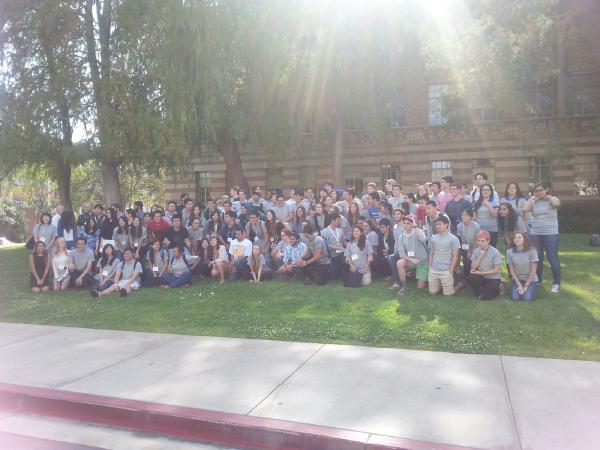
Below is the first of several exciting data science developments for the younger generation, happening right here in Los Angeles. This project is unique because it engages undergraduates in real data analysis, something that happens quite rarely in a classroom. If projects like this catch on as a new trend, we’re going to have some real competition for our jobs in a few years!
Welcome! We are launching DataScience.LA to provide a home for all the content (slides, code, videos etc.) for several meetups in LA (Data Science/Machine Learning, R, DataVis etc.) and to engage the Los Angeles data science community in an open, active discussion about best practices and new developments in the field.