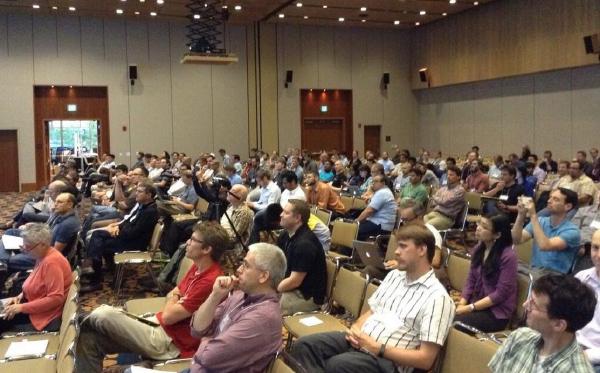
At this meetup, five more LA R meetup members will present short talks of what they have learned at useR! 2014. This is the 2nd round of talks about useR! since we had twice as many volunteers to speak as we could accommodate in one meetup (indeed, useR! was that awesome). The first round of talks at our September meetup is summarized here (with slides).
I’m pleased to announce the first event of our new Python Data Science LA meetup, started by two of us here at DataScience.LA (our very own Szilard and Eduardo).
We’ll have 5 speakers at this event, covering various aspects of the Python Data Science ecosystem (NumPy, SciPy, pandas, matplotlib, scikit-learn, NetworkX, NLTK, IPython notebook, etc.)
There comes a time in a software toolchain’s lifecycle where the focus shifts from developer productivity and preference to the ability to deploy solutions in production which coexist gracefully in the enterprise. Configuration management and dependency management are two of the first points of friction in this transition, as the free-wheeling methods preferred by developers are at odds with the structured methods and isolation desired by administrators, who serve as gatekeepers to enterprise deployment. R is currently at this very point in the transition, in the midst of transformation from a language and environment used primarily in academic research to its growing place in the enterprise. At useR! 2014 there were a series of presentations on how dependency management can be addressed within the R ecosystem, ranging from “provider” side options (e.g. freezing CRAN and private repositories) to the client side options, where a project maintains its own dependencies as part of its codebase.
In science consensus is irrelevant. What is relevant is reproducible results. The greatest scientists in history are great precisely because they broke with the consensus.
– Michael Crichton
Yihui Xie intended to make it easier to do his homework, but instead found himself tackling one of the greatest problems in modern science: the reproducibility of results.