↓ Skip to main content

shiny

2015

Yihui Xie presents HTML Widgets

Yihui Xie presents HTML Widgets

The Shiny framework, by RStudio, is growing in popularity as a tool that makes it easy for R developers to leverage the web as a deployment platform for sharing their analysis. However, since the very earliest release of Shiny, the development group has been bombarded with the same series questions over and over again, questions like “Does it work with d3.js?” and “Can I use JavaScript in Shiny?”
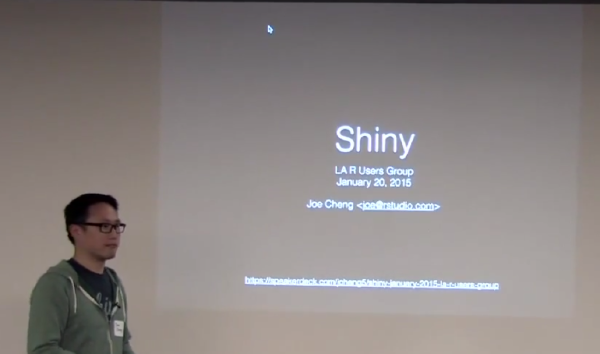
Joe Cheng presents Shiny

Joe Cheng presents Shiny

·1 min
The Shiny framework is a web application framework for the R programming language, designed by Joe Cheng, to help R programmers turn their analysis into interactive web applications. Fortunately, it does without requiring that the R programmer know HTML, CSS or JavaScript - greatly widening the possible audience of users. At the January DataScience.LA R Meetup, we were fortunate to have Joe Cheng, Software Engineer at RStudio and original architect of Shiny present an introduction to Shiny.
Secure your Shiny apps (against SQL injection)

Secure your Shiny apps (against SQL injection)

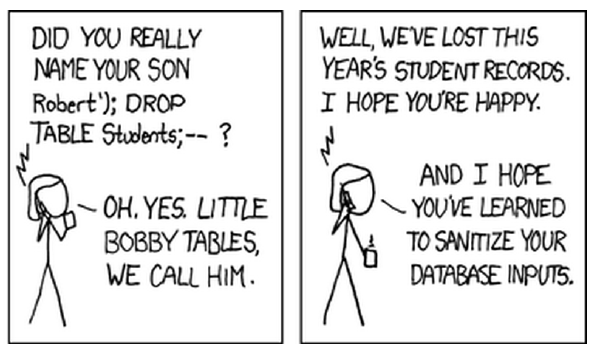
Shiny takes inputs from UI elements and sends them to the server, where the application can access them as R variables. While Shiny has security measures in place, as in any typical web application, it remains the developer’s responsibility to sanitize the inputs before using them. For example, Shiny has no way to protect you if you are using an input in a SQL query such as select ... from ... where field = 'input'. Someone manipulating the websocket communication can craft a specially-formatted input that can force the database to execute a query that it is not supposed to do, termed an SQL injection. This might give an attacker access to private data or the ability to do other nefarious things, and it is a common security issue.


2014

LA R meetup - January 21: RStudio's Shiny with Joe Cheng

LA R meetup - January 21: RStudio's Shiny with Joe Cheng

At this meetup we’re fortunate to have RStudio’s lead developer Joe Cheng flying in from Seattle to talk about Shiny. Shiny makes it possible to develop interactive web applications by writing only a handful of R code. It lowers the barriers to constructing interactive dashboards that you can use to better explain your results to your boss and/or co-workers, or it can help you productionalize your analysis so that others in your company can make use of it regularly without the need to continually bother you.

A Conversation with Joe Cheng at useR! 2014

Joe Cheng is a software engineer. Unfortunately the term gets thrown around pretty lightly, so I’d like to make sure that I convey the appropriate amount of gravitas when I refer to him as such. Joe Cheng is a *great* Software Engineer. He has worked for some of the largest technology companies on the planet, building cutting edge tools which empowered the web browser as a full blown platform instead of a historical curiosity. Joe is one of those software engineers who saw a future with the web as a platform for modern software, then worked hard to make it a reality. When the time came to build the next generation of data science IDEs, an IDE targeting the web as a platform, RStudio called Joe.

Shiny: R made interactive @ useR! 2014

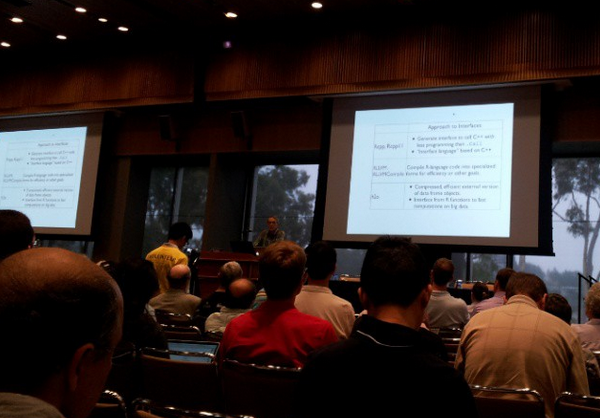
At useR! 2014, one of the most anticipated presentations was Joe Cheng’s Shiny: R made interactive. It was but one of the of a fantastic series of talks by RStudio representatives; check out Winston Chang’s ggvis: Interactive graphics in R for another great talk. Shiny begins with your R code and ends with the customer’s view: an interactive, browser-accessible application. This enables you to place a great deal of power into your users’ hands to customize their view and provides a variety of new and innovative ways to interact with the data, such as by tuning parameters and focusing on sub-populations. Essentially, Shiny functions by allowing you to “wire up” up a reactive application, greatly speeding up the development of a data and analysis based web app.