What has Kaggle learned from 2 million machine learning models?
Anthony Goldbloom, founder and CEO of Kaggle
UPDATE:Video recording of the talk available here
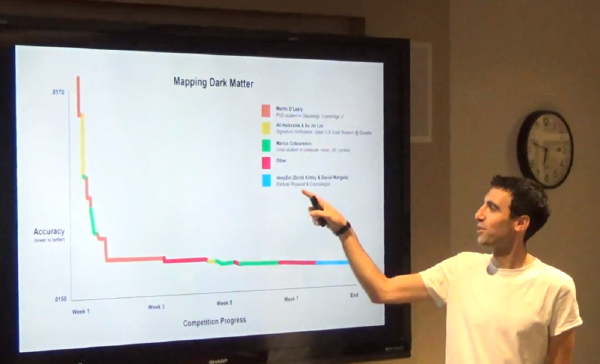
Kaggle is a community of almost 450K data scientists who have built almost 2MM machine learning models to participate in our competitions. Data scientists come to Kaggle to learn, collaborate and develop the state of the art in machine learning. This talk will cover some of the lessons on winning techniques we have learned from the Kaggle community.
This meetup will be hosted by Google and we’ll have Peter Lipman and Pete Meyer talk about the data science/statistics projects they have been working on at Google.
Human Evaluation Comparisons: Common Framework with Applications
We designed a study to determine whether being on device influenced a quality evaluator’s perception of ads quality. Here, we present a common framework, developed into an internal R package, that was used to analyze the study.
I ♥ data. But I also ♥ privacy. Even though I have been running a few data meetups for the past few years, I have managed to keep myself out of public eye - even in my professional life. I must admit, I’m giving a bit away in an recent interview with Data Science Weekly. They had excellent questions to pose, and I’d like to take a moment here to summarize two main points from the interview: my thoughts on when and how much time it took me to became a data scientist and how I feel about the hype in the field today. If you’d like, you can read the full interview here.
David Diez works on the OpenIntro team, which develops open-source textbooks, statistical software labs, and other course resources for intro-level statistics. This video above is the talk he gave at useR! 2014 entitled “Textbooks fail where Software Succeeds” in which he outlines the challenges unique to open-source textbooks, the state of OpenIntro, and how people can get involved. Below, he discusses these challenges further and offers his thoughts around their solutions.
(This is my third post on statistics graduate school. You can read the first, on coursework, the difference between a Masters and a PhD, and proving your worth here, and the second, on advancing to candidacy, writing the dissertation, and having fun in grad school, here.)
Martin Maechler is a member of R-Core. This distinction puts him in the very apex of understanding of the R programming language and environment. He is a professor of statistics with wide and varied interests and a leading expert in statistical computing environments. He is also a prolific programmer, evidenced by his maintenance of the officially recommended cluster package for unsupervised clustering and analytics, the lead developer of Emacs Speaks Statistics, and co-maintainer of the Matrix package… plus too many other contributions to list them all here.
(Note: This is my second installment on grad school, you can read the first part on coursework, the difference between a Master’s and a Ph.D., and proving your worth, here.)
Advancement to candidacy # After finishing coursework, the next step in our PhD program is to “advance to candidacy.” This is the formal process of proposing your dissertation research. Our department has a diverse set of research interests, both theoretical and applied, so dissertations can take a variety of forms. This is yet another difference between Master’s and PhD projects– typically, Master’s projects are more directed by faculty members and PhD projects are chosen primarily by the students themselves. Either way, the process begins with a conversation between the student and his/her advisor.
As a PhD graduate student in statistics here at UCLA, I’d like to talk a bit about our graduate program to give you an idea of what to expect if you’re interested in UCLA or statistics graduate school in general. First, it’s important to note that UCLA does not have a specific “data science” degree program at this point; the department offers a PhD and a Master’s degree, both simply labeled “statistics.” Some statistics departments have made the decision to change their name to “data science,” but that is often just a marketing decision. The UCLA department is pretty forward-thinking and has a focus on computation, so it’s fairly “data science”-y without having that exact name.